Annual Reports
Expand Energy Corporation's annual reports contain management's most considered account of the business. These are the sections, passages and visual pages worth opening in the originals preserved in Sources.
Expand Energy Corporation — FY2025 Annual Report (Form 10-K) — FY2025
The first full year as Expand Energy: post-Southwestern, investment-grade, S&P 500, the largest U.S. gas producer. · Open the full document →
Item 1. Business — p. 18 · Read the full section →
What the company is today — a three-basin, pure-play gas producer built by the October 2024 Southwestern merger.
Largest U.S. gas producer across Haynesville and Appalachia; $1.2B debt cut, S&P 500, $865M returned.
Expand Energy is the largest independent natural gas producer in the U.S., based on net daily production, and is focused on responsibly developing an abundant supply of natural gas, oil and NGL to expand energy access for all. Our operations are located in Louisiana and Texas in the Haynesville and Bossier Shales (“Haynesville”), in Pennsylvania in the Marcellus Shale (“Northeast Appalachia”) and in West Virginia and Ohio in the Marcellus and Utica Shales (“Southwest Appalachia”) and include working interests in approximately 6,600 gross natural gas and oil wells. […] Since completing our merger with Southwestern, we’ve continued to focus on strengthening our balance sheet by reducing total debt by approximately $1.2 billion and upsized our 2025 Credit Facility capacity to $3.5 billion. In 2025, we joined the S&P 500 index and returned approximately $865 million to shareholders through dividends and share repurchases.
p. 18 · Read in context →
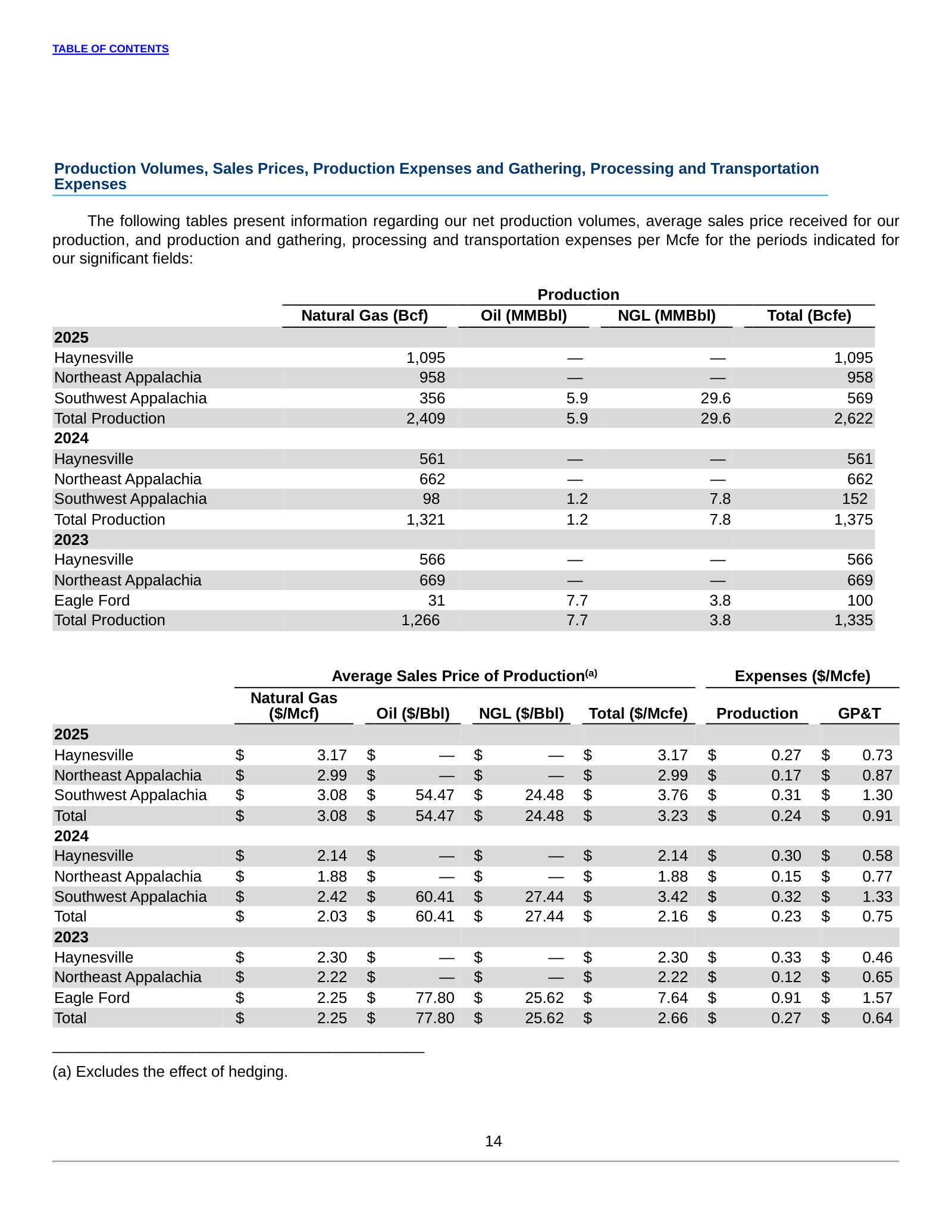
Natural Gas, Oil and NGL Reserves — p. 22 · Read the full section →
The core asset: 25.9 Tcfe proved, a $17.1B standardized measure, and how PUDs nearly doubled in a year.
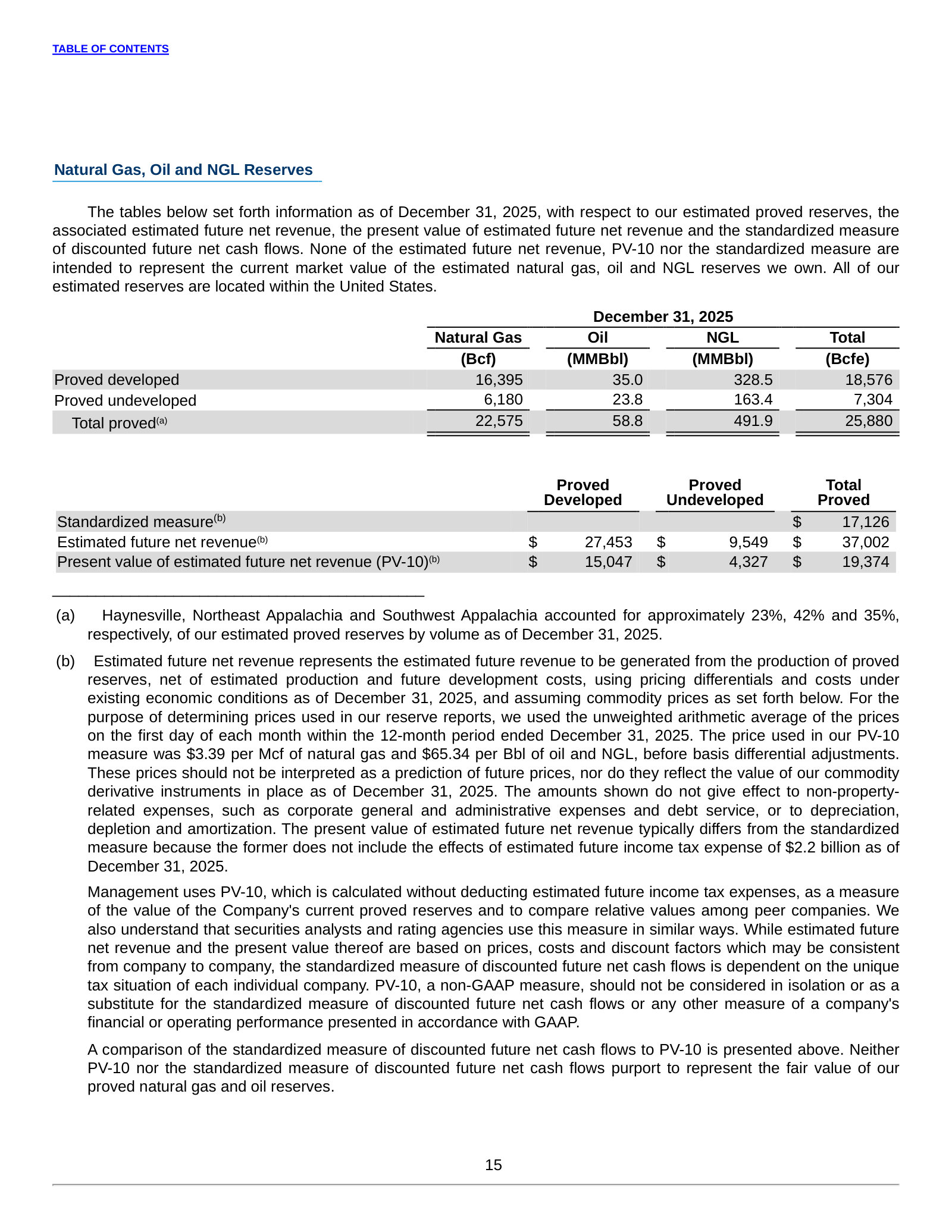
PUDs jumped to 7,304 Bcfe on a 4,998 Bcfe upward revision from newly economic locations.
As of December 31, 2025, our proved reserve estimates included 7,304 Bcfe of reserves classified as proved undeveloped, compared to 3,842 Bcfe as of December 31, 2024. […] We had a net upward revision in previous estimates of 4,998 Bcfe. The net upward revision primarily consisted of 5,430 Bcfe of upward revisions due to new PUDs that had improved economics and were in areas previously classified as proved.
p. 23 · Read in context →
Item 1A. Risk Factors — p. 42 · Read the full section →
The two risks that actually move this stock: gas-price swings and the property write-downs they trigger.
Results depend primarily on the prices received for gas, oil and NGL; sustained lows bite.
Our revenues, results of operations, profitability, liquidity, leverage ratio and ability to grow and invest in capital expenditures depend primarily upon the prices we receive for the natural gas, oil and NGL we sell. We incur substantial expenditures to replace reserves, sustain production and fund our business plans. Low natural gas, oil and NGL prices can negatively affect the amount of cash available for capital expenditures, debt service and debt repayment and our ability to borrow money or raise additional capital and, as a result, could have a material adverse effect on our financial condition, results of operations, cash flows and reserves.
p. 42 · Read in context →
Successful-efforts impairment: low prices or reserve cuts force non-cash write-downs of property.
The successful efforts method of accounting requires that we periodically review the carrying value of our natural gas and oil properties for possible impairment. Impairment is recognized for the excess of book value over fair value when the book value of a proven property is greater than the expected undiscounted future net cash flows from that property and on acreage when conditions indicate the carrying value is not recoverable. […] A write-down constitutes a non-cash charge to earnings and does not impact cash or cash flows from operating activities; however, it reflects our longterm ability to recover an investment, reduces our reported earnings and increases certain leverage ratios.
p. 46 · Read in context →
Item 7. MD&A — Recent and Significant Developments — p. 89 · Read the full section →
The year's defining events — $7.9B merger close, investment-grade ratings, capital returns, and a February 2026 CEO change.
Southwestern merger closed for ~$7.9B in stock; S&P assigned a BBB- investment-grade rating.
On October 1, 2024, we completed the Southwestern Merger and issued approximately 95.7 million shares of our common stock to Southwestern’s shareholders in connection with the Merger Agreement. […] On October 1, 2024, we received an investment grade rating from S&P Global Ratings (“S&P”). S&P assigned an issuer-level rating of ‘BBB-’ on our unsecured debt and raised our issuer credit rating to ‘BBB-’, with a stable outlook.
p. 89 · Read in context →
2025 capital-return framework: $2.30 base dividend, $1B debt reduction, 75% of remaining FCF.
In 2025, we prioritized paying the base dividend of $2.30 per share and $1.0 billion of annual net debt reduction, with 75% of the remaining free cash flow distributed, as market conditions warranted, through share repurchases and additional dividend payments. During 2025, we made dividend payments of $765 million, repurchased 0.9 million shares for an aggregate price of $100 million, reduced the principal amount of our debt through senior notes repayments as noted above, and increased our cash on hand.
p. 90 · Read in context →
Item 7. MD&A — Results of Operations — p. 98 · Read the full section →
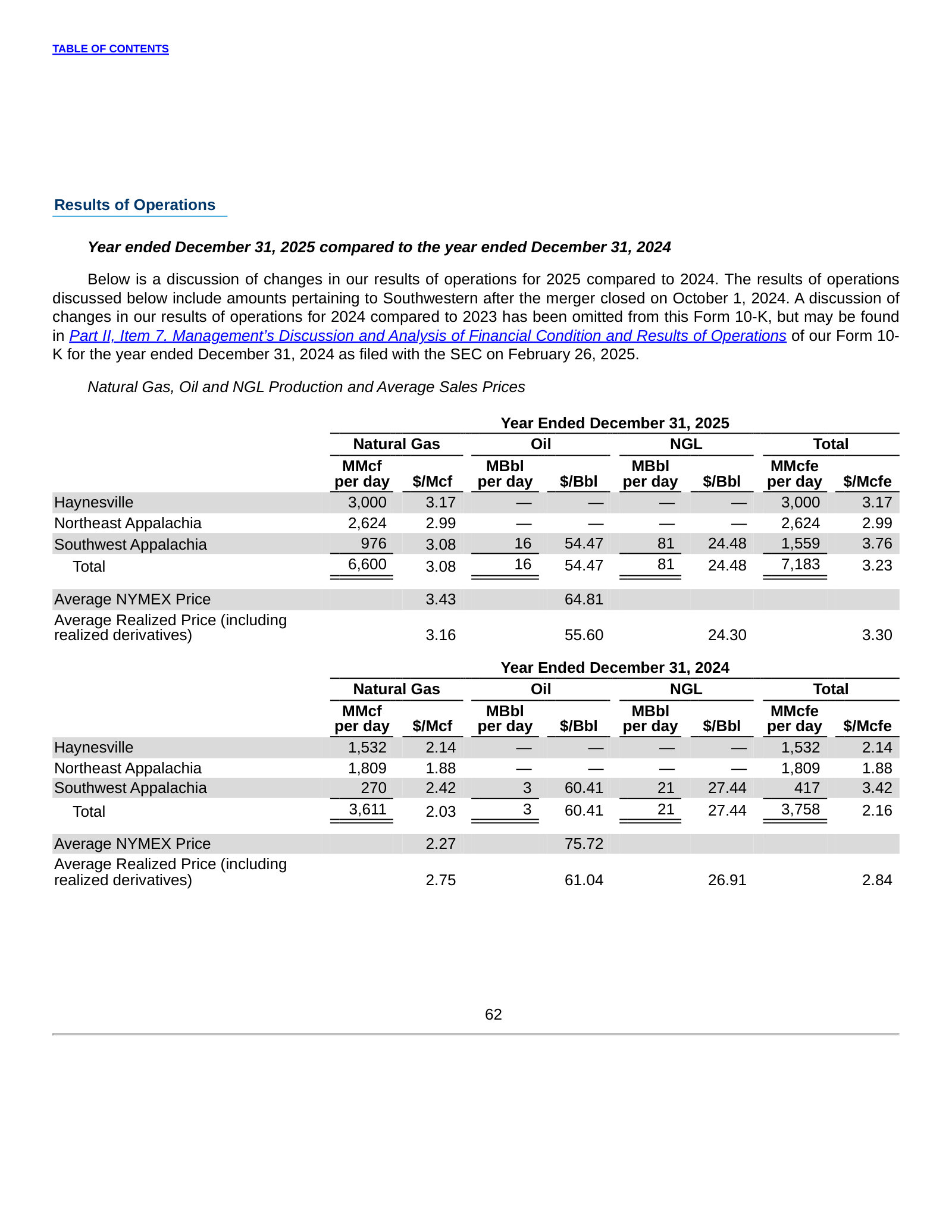
How a full year of Southwestern roughly doubled volumes, and how hedging shaped realized prices versus NYMEX.
Critical Accounting Estimates — p. 105 · Read the full section →
The accounting choices that govern earnings: reserve estimates and the successful-efforts method.
Reserves are the most significant estimate; properties carried under the successful-efforts method.
Natural Gas and Oil Reserves. Estimates of natural gas and oil reserves and their values, future production rates, future development costs and commodity pricing differentials are the most significant of our estimates. […] The Company’s principal assets are its natural gas and oil properties, which are accounted for under the successful efforts accounting method. The Company determines the fair value of acquired natural gas and oil properties based on the discounted future net cash flows expected to be generated from these assets.
p. 105 · Read in context →
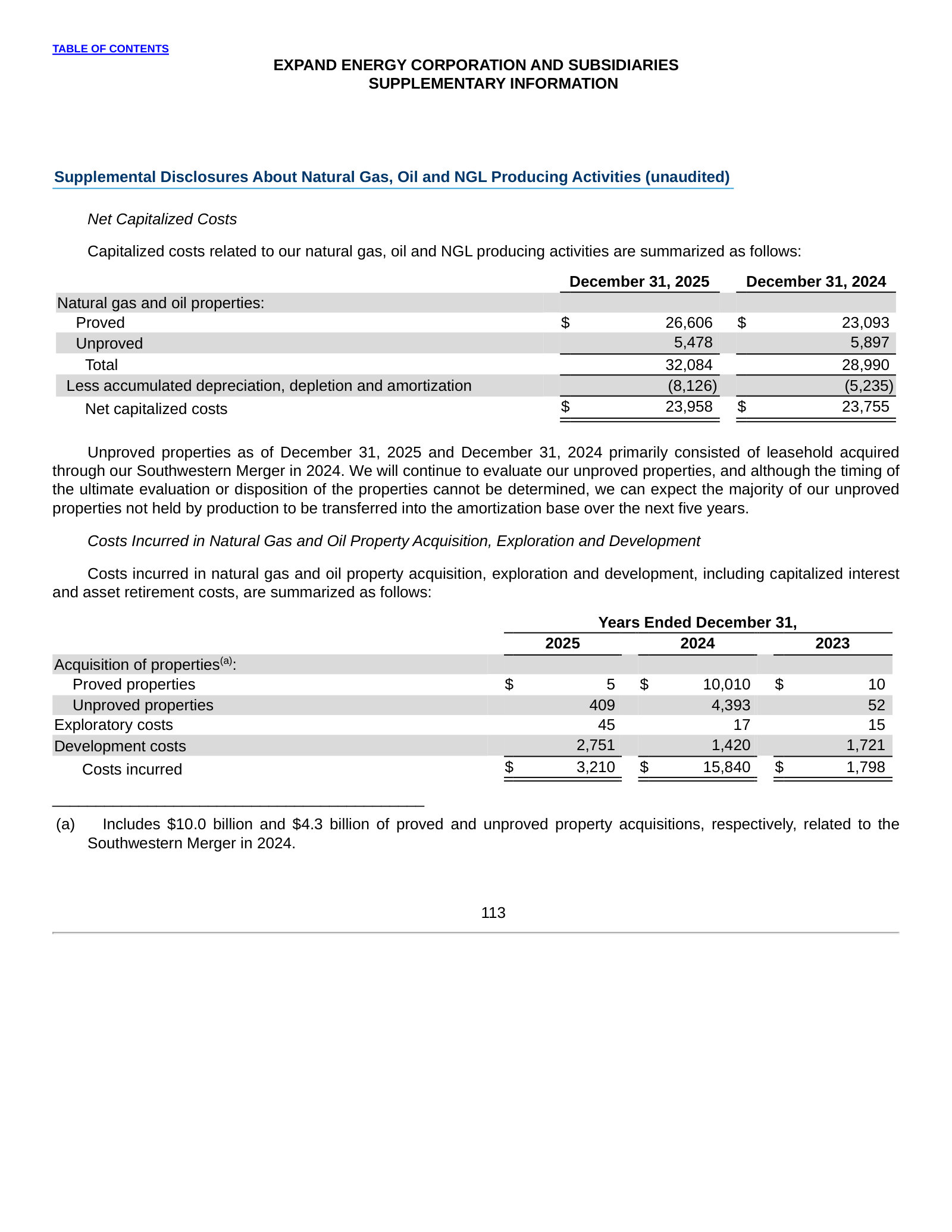
Supplemental Disclosures About Natural Gas, Oil and NGL Producing Activities (unaudited) — p. 165 · Read the full section →
The E&P-specific disclosures — capitalized costs, costs incurred, and the standardized-measure roll-forward.
Chesapeake Energy Corporation — FY2021 Annual Report (Form 10-K) — FY2021
The pre-merger identity: a freshly bankruptcy-exited, oil-and-gas Chesapeake — worth seeing against today's pure-gas Expand. · Open the full document →
Item 1. Business — p. 12 · Read the full section →
Chesapeake just out of Chapter 11 — 8,200 oil-and-gas wells, buying Vine/Chief, selling Powder River, refocusing on gas.
More annual reports
Expand Energy Corporation — FY2024 Annual Report (Form 10-K) — FY2024 · 192 pages · First 10-K under the Expand Energy name; the Southwestern merger closes and the rebrand takes effect. · Open →
Chesapeake Energy Corporation — FY2023 Annual Report (Form 10-K) — FY2023 · 223 pages · Last full year as standalone Chesapeake before the merger; Eagle Ford oil exit underway. · Open →
Chesapeake Energy Corporation — FY2022 Annual Report (Form 10-K) — FY2022 · 181 pages · Chief/Marcellus additions and Powder River sale complete the pivot to a three-basin gas producer. · Open →